“The King Who Must Be Praised”

As We Get Ready For Resurrection Sunday
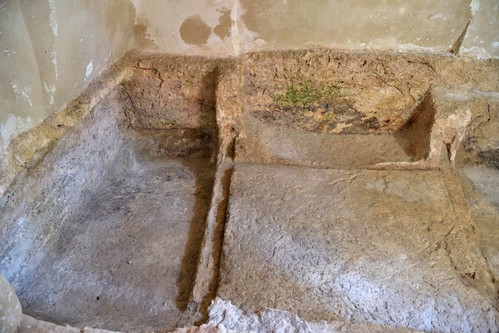
The Empty Tomb found at the Garden Tomb in Israel.  - Israel 2022 

Day 8 - Sunday - Resurrection Sunday

The King Who Must Be Proclaimed
Text: Matthew 28:1–10; Luke 24:1–12
The week began with a King entering Jerusalem to shouts of praise. It ends with a risen King leaving an empty tomb—and a message that cannot be contained.
Early on the first day of the week, the women came to the tomb carrying spices, expecting to honor a dead Savior. Instead, they encountered the shocking reality at the heart of the gospel: “He is not here, for He has risen, as He said.” The stone was rolled away, not to let Jesus out, but to let witnesses in.
Resurrection Sunday is not merely a celebration—it is a declaration. The crucified King is now the risen King. Death has been defeated. Sin has been paid for. The grave has lost its grip.
From Fear to Proclamation
Both Matthew and Luke show us that the first witnesses did not immediately respond with bold confidence. They were afraid, confused, and overwhelmed. Yet, in that mixture of fear and joy, Jesus met them.

“Do not be afraid… go and tell my brothers…” (Matthew 28:10)

That command changes everything. The resurrection is not news to be admired privately—it is truth to be proclaimed publicly. The women became the first messengers of the resurrection. In a culture that often discounted their testimony, God chose them to carry the greatest announcement in history. This reminds us that the power of the message does not depend on the status of the messenger.
The Reality of the Empty Tomb
Luke emphasizes the physical reality of the resurrection. The tomb was empty. The body was gone. The grave clothes remained. Angels testified to what had happened.
Even then, the disciples struggled to believe. Verse 11 tells us their words seemed like “idle tales.” But Peter ran to the tomb—and what he saw began to shift everything.
The resurrection is not myth or metaphor. It is a historical, bodily reality. Christianity stands or falls on this truth. As later written in 1 Corinthians 15:14, “If Christ has not been raised, then our preaching is in vain and your faith is in vain.”
But He has been raised—and that changes everything.
Why the King Must Be Proclaimed
Because the tomb is empty, the message must go out.
  • Proclaimed because of victory – Jesus has conquered sin, death, and hell.
  • Proclaimed because of hope – The resurrection guarantees eternal life for all who believe.
  • Proclaimed because of authority – The risen King now reigns and will return.
  • Proclaimed because of urgency – The world must hear this good news.
The resurrection moves us from spectators to witnesses. We are not just recipients of grace—we are carriers of the gospel.
A Personal Encounter Leads to a Public Witness
Notice in Matthew’s account: the women encountered Jesus before they proclaimed Him. Their message was not secondhand—it flowed from a personal meeting with the risen Christ.
This is still true today. Bold proclamation is born out of real relationship. You cannot effectively share a Savior you do not truly know.
Application
  • Believe the resurrection fully – not just as doctrine, but as reality that reshapes your life.
  • Live in resurrection hope – your past is forgiven, your future is secure, your present has purpose.
  • Proclaim the risen King – in your home, your church, your workplace, and your community.
  • Move beyond fear – like the women, let reverent awe turn into obedient action.
Prayer
Lord Jesus,
You are the risen King, victorious over death and the grave. Thank You that the tomb is empty and our hope is alive. Strengthen my faith to believe this truth deeply and boldly. Give me courage to proclaim Your name without fear. Let my life reflect the power of Your resurrection, and use me to share this good news with others.
Amen.
Key Truth
The resurrection is not just something to celebrate—it is a message to proclaim. The King who was crucified is alive, and the world must hear it.

Day 7 - Saturday - God is Still Working

The King Who Must Be Trusted in Silence
Text: Matthew 27:57–66
Key Thought
God is still working—even when heaven seems silent.
Devotional
Saturday is the quietest day of Passion Week. The crowds are gone. The miracles have ceased. The cross stands empty, and Jesus lies in a borrowed tomb. From a human perspective, everything looks finished. Joseph of Arimathea courageously asks for Jesus’ body and lays Him in the tomb, wrapping Him with care and dignity. A large stone is rolled into place. The religious leaders, still driven by fear and control, request guards to secure the tomb, attempting to prevent any claim of resurrection.
And then… silence.

No words from Jesus.
No visible movement from God.
No immediate fulfillment of hope.

For the disciples, this was a day of confusion, grief, and shattered expectations. The One they believed to be King now appeared defeated. The promises seemed buried behind a sealed stone. Yet what they could not see was this: God was not absent—He was at work. Saturday reminds us that there are seasons when God’s activity is hidden. The silence is not abandonment; it is often preparation. The stillness is not defeat; it is the space between promise and fulfillment.
We live much of our lives in “Saturday moments.”
  • When prayers feel unanswered
  • When circumstances don’t change
  • When God seems quiet
  • When hope feels delayed
In those moments, we are called not to understand—but to trust. The same God who was working in the darkness of the tomb is working in the quiet places of your life.
The stone was sealed, but it was not permanent. The silence was real, but it was not final.
Sunday was coming.
Application
  • Trust God even when you cannot trace Him.
  • Resist the urge to interpret silence as absence.
  • Remember that God often does His deepest work out of sight.
  • Hold on to His promises when circumstances seem to contradict them.
Faith is not proven in the noise of miracles—it is refined in the silence between them.
Reflection Questions
  1. Where in your life are you experiencing a “Saturday” season?
  2. How do you typically respond when God feels silent?
  3. What promises of God can you hold onto during this time?
  4. How can you choose trust over fear today?
Prayer
Lord,
In the quiet moments when I don’t see You moving, help me trust that You are still at work. Strengthen my faith when answers are delayed and hope feels distant. Teach me to rest in Your promises, even in the silence. I believe that what You have said, You will accomplish. Help me wait with confidence, knowing that Your timing is perfect.
Amen.
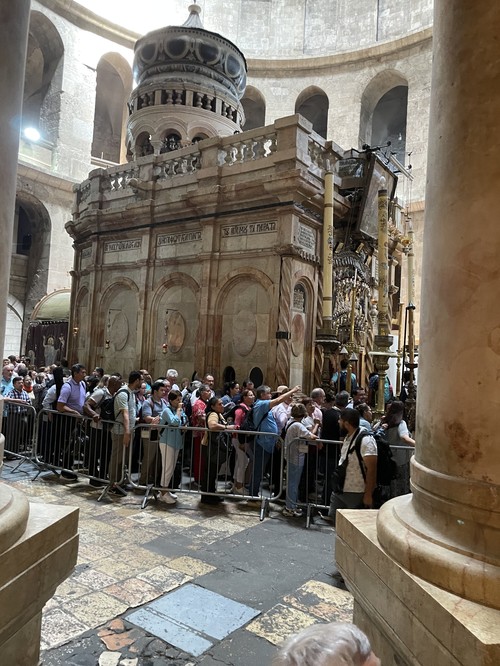
Again, tomb inside the The Church of the Holy Sepulchre,  known as the Edicule, is one of the places where it is believed that  Jesus was laid down.  - Israel 2022 
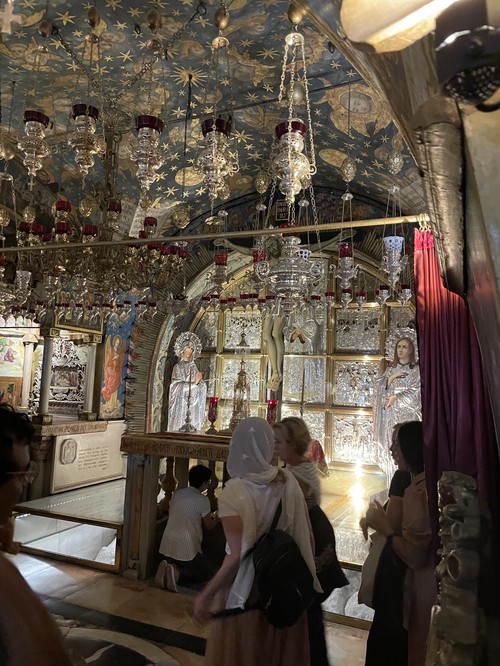
Inside the The Church of the Holy Sepulchre is one place where it is believed Jesus was crucified.  - Israel 2022 

Day 6 - Good Friday

The King Who Must Be Crucified
Text: John 18–19; Isaiah 53
Opening Thought
Friday of Passion Week is the darkest day in human history—and at the same time, the most glorious. The King who entered Jerusalem to shouts of praise now stands rejected, beaten, and condemned. This is not a tragic accident. It is the very plan of God.
The King must be crucified—not because He is guilty, but because we are.
Scripture Focus
In John 18–19, we see the unfolding of Jesus’ arrest, trial, and crucifixion. He is betrayed, denied, mocked, and condemned by both religious and political authorities. Yet throughout it all, He remains in complete control.
Centuries earlier, Isaiah 53 foretold this very moment:
  • “He was despised and rejected by men…”
  • “He was pierced for our transgressions…”
  • “The Lord has laid on Him the iniquity of us all.”
This is not coincidence—it is fulfillment.
The King on Trial
Jesus stands before Annas, Caiaphas, and Pilate. Ironically, the only truly innocent man to ever live is the one being judged.
Pilate asks, “What is truth?” while Truth Himself stands in front of him.
Despite finding no guilt in Jesus, Pilate gives in to the crowd. The people cry out:
“Crucify Him!”
The King is rejected by His own people.
The King Who Suffers
Jesus is scourged, mocked, and crowned with thorns. Soldiers dress Him in a purple robe, sarcastically hailing Him as king.
Yet every moment fulfills prophecy.
Isaiah described Him as:
  • “A man of sorrows”
  • “Stricken, smitten by God, and afflicted”
  • “Like a lamb led to the slaughter”
He does not resist. He does not retaliate.
Why? Because this suffering is substitution.
The King on the Cross
At Golgotha, Jesus is crucified.
John records His final moments with powerful simplicity:
  • “Woman, behold your son…”
  • “I thirst.”
  • “It is finished.”
That final statement is not a cry of defeat—it is a declaration of victory.
The work of redemption is complete.
The wrath of God against sin has been fully satisfied.
Isaiah said:
“He shall bear their iniquities.”
And now, He has.
The King Who Dies
Jesus willingly gives up His spirit. No one takes His life from Him—He lays it down.
The soldiers pierce His side, confirming His death. Blood and water flow—a powerful reminder of both sacrifice and cleansing.
The King is placed in a borrowed tomb.
Silence falls.
Hope seems lost.
But this is not the end.
Why the King Must Be Crucified
The cross is not optional—it is necessary.
  • Because of sin: “All we like sheep have gone astray…”
  • Because of justice: God’s holiness demands payment
  • Because of love: “By His wounds we are healed”
Jesus is not just a victim of injustice—He is the willing substitute.
He takes our place.
He bears our punishment.
He satisfies God’s wrath.
This is the heart of the gospel.
Application
  1. See the seriousness of sin
    The cross reveals that sin is not small—it required the death of the Son of God.
  2. Rest in the finished work of Christ
    “It is finished” means there is nothing left for you to earn. Salvation is complete in Him.
  3. Respond with surrender
    If Jesus gave everything for you, the only fitting response is to give your life to Him.
  4. Live in gratitude and humility
    The cross removes all pride. We are saved only by grace.
Reflection Questions
  • What stands out most to you about Jesus’ suffering and silence?
  • How does the cross deepen your understanding of sin and grace?
  • Are you trusting fully in the finished work of Christ, or trying to earn God’s favor?
Prayer
Lord Jesus,
Thank You for going to the cross for me.
You were innocent, yet You took my place.
You suffered what I deserved.
Help me to never take the cross lightly.
Teach me to live in gratitude, humility, and surrender.
Because You gave everything for me,
I give my life to You.
Amen.
Closing Thought
The King who must be crucified is the only King who can save.
What looked like defeat was actually the greatest victory in history.
Sunday is coming.

Day 5 - Thursday: Breaking Bread

The King Who Must Be Remembered
Text: Luke 22:7–38; John 13:1–17
Opening Reflection
Thursday of Passion Week brings us into the upper room—an intimate, weighty moment between Jesus and His disciples. The shadow of the cross is now unavoidable. Every word carries urgency. Every action is intentional.
This is the night where the King does two unforgettable things:
  • He institutes a memorial
  • He models humility
Both are given so that He would never be forgotten—not merely in memory, but in ongoing, life-shaping devotion.
First, There is a Meal That Must Never Be Forgotten (Luke 22:14–20)
As Jesus shares the Passover with His disciples, He transforms it forever.

“Do this in remembrance of Me.”

The Passover had always been about remembering God’s deliverance from Egypt. But now, Jesus reveals a greater deliverance—the rescue from sin through His own body and blood. The bread becomes a symbol of His body, soon to be broken and the cup becomes a symbol of His blood, soon to be poured out. This is not just a ritual—it is a re-centering of life around Christ’s sacrifice.
To remember Jesus biblically is not passive recollection. It is:
  • To bring His sacrifice into present focus
  • To live in light of what He has done
  • To anchor our identity in His grace
We are forgetful people. We drift. We grow cold. That is why Jesus gave us something tangible—the Lord’s Supper—to call us back again and again. The King must be remembered because His sacrifice is everything.
Second, There is A Love That Stoops Low (John 13:1–17)
Before the meal is finished, Jesus does something shocking. The King of glory rises from the table, wraps Himself in a towel, and begins to wash His disciples’ feet. This task belonged to the lowest servant. Yet Jesus willingly takes that place.

“If I then, your Lord and Teacher, have washed your feet, you also ought to wash one another’s feet.”

This moment reveals the heart of the King:
  • He is not distant, but near
  • Not proud, but humble
  • Not self-serving, but self-giving
Even more striking—He washes the feet of Judas, the one who would betray Him.
This is not just an act of service. It is a preview of the cross:
  • Cleansing
  • Humbling
  • Sacrificial love poured out for the undeserving
To remember Jesus rightly is to remember how He loved.
Third, There is a Betrayal That Reveals the Heart (Luke 22:21–34)
In the midst of this sacred evening, Jesus reveals a painful truth—He will be betrayed.
  • Judas will hand Him over
  • Peter will deny Him
  • The disciples will scatter
Even here, we see the depth of Christ’s mercy:
  • He offers bread to Judas
  • He prays for Peter’s restoration
Jesus is not surprised by human weakness. Yet He moves forward in love.
This reminds us that remembering Jesus also means remembering:
  • His patience with our failures
  • His faithfulness despite our inconsistencies
Fourth, There is a Kingdom Re-Defined (Luke 22:24–30)
Even on this night, the disciples argue about greatness.
Jesus responds with a radical redefinition:

“I am among you as the One who serves.”

In His Kingdom:
  • Greatness is measured by humility
  • Leadership is expressed through service
  • Power is displayed in sacrifice
To remember the King is to live differently:
  • Serving instead of striving
  • Giving instead of grasping
  • Humbling ourselves instead of exalting ourselves
And Finally, There is a Call to Ongoing Remembrance
Jesus did not say, “Think of Me occasionally.”
He established a rhythm:
  • Gather
  • Break bread
  • Share the cup
  • Remember
This remembrance is meant to shape:
  • Our worship (centered on the cross)
  • Our relationships (marked by humility)
  • Our mission (proclaiming His death until He comes)
To forget Jesus is to drift into self-centered living.
To remember Him is to be brought back to grace, truth, and purpose.
Application
  • Remember intentionally: Do you regularly reflect on Christ’s sacrifice, or has it become familiar?
  • Serve humbly: Where can you take the lower place this week?
  • Examine your heart: Is there any area where you are drifting, denying, or resisting Him?
  • Re-center your life: Let the cross define your identity and direction
Prayer
Lord Jesus,
You are the King who gave everything so that I might be saved. Forgive me for how easily I forget.
Help me to remember Your sacrifice—not just in word, but in the way I live. Teach me to walk in humility, to serve others, and to love as You have loved me. Keep my heart close to the cross. Let my life be a continual remembrance of You.
Amen.
Closing Thought
The King who washed feet…
The King who broke bread…
The King who gave His life…
This is the King who must be remembered—not just today, but every day.
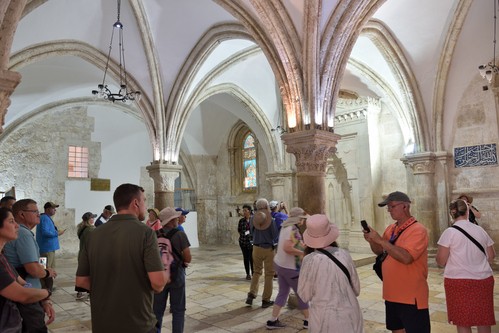
The location believed to be where the upper room was located. It was been changed over the years since that night of remembrance.  - Israel 2022 
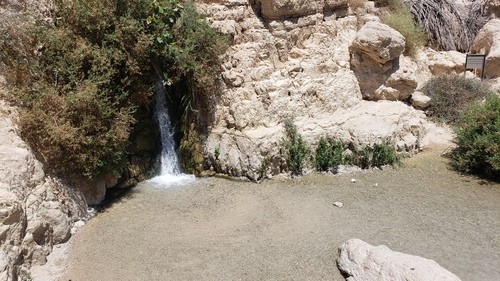
In the silence of the dessert over looking the Dead Sea breaks a sound of water around the next bend. The En Gedi, an oasis in the middle of the dessert where it is believed that David would go to hide from King Saul - Israel 2022 

Day 4 – Silent Wednesday

The King Who Is Worthy of Sacrifice
Text: Matthew 26:6–16; Mark 14:3–11
Wednesday of Passion Week is often called Silent Wednesday, because the Gospel accounts do not record major public teaching from Jesus on this day. Yet behind the scenes, two powerful and contrasting acts unfold—one of extravagant worship, and one of calculated betrayal.
In Bethany, a woman (identified in John’s Gospel as Mary) approaches Jesus with an alabaster jar of very expensive perfume. Without hesitation, she breaks it and pours it out on Him. This was no small gesture—this perfume was worth nearly a year’s wages. It was costly, personal, and irreversible. Once broken and poured out, it could not be taken back.
While some disciples criticized her act as wasteful, Jesus saw it rightly. He declared it beautiful. In fact, He connected her sacrifice directly to His coming burial. She understood something others did not: the King was about to give His life, and He was worthy of her very best.
Immediately following this moment, we see a chilling contrast. Judas Iscariot goes to the religious leaders and agrees to betray Jesus for thirty pieces of silver. While one heart pours out treasure in worship, another trades the Savior for a price.
This contrast forces us to ask a deeper question: What is Jesus worth to me?
Key Truth
Jesus is a King who is not merely to be admired—He is worthy of costly, sacrificial devotion.
Application
1. True Worship Costs Something
The woman’s offering was extravagant because her love was deep. Worship that costs nothing often means little. Whether it is your time, resources, reputation, or comfort—honoring Christ requires sacrifice.
Ask yourself: What am I holding back from Jesus?
2. You Cannot Remain Neutral About Jesus
Wednesday reveals two responses: worship or betrayal. There is no middle ground. Judas didn’t reject Jesus publicly at first—he simply allowed his heart to drift until he was willing to trade Jesus for something lesser.
Consider: Am I fully surrendered, or quietly compromising?
3. Jesus Sees and Values Your Devotion
Even when others misunderstood the woman’s act, Jesus defended her. He receives every genuine act of love and honors it. Nothing given to Christ in sincerity is ever wasted.
Be encouraged: Your sacrifice for Jesus matters more than you realize.
Reflection Questions
  • What does my current level of sacrifice reveal about how much I value Jesus?
  • In what ways am I tempted to “exchange” devotion to Christ for something else?
  • What is one tangible act of worship I can offer to Jesus today?
Prayer
Lord Jesus, You are worthy of my very best. Forgive me for the times I have given You leftovers instead of sacrifice. Give me a heart like this woman—willing to pour out everything in love and devotion. Guard me from a divided heart like Judas. Help me to treasure You above all else. Amen.

Day 3 – Tuesday: Tension

Title: The King Whose Authority Must Be Acknowledged
Text: Mark 11:20–33; Matthew 21:23–46
Tuesday of Passion Week is marked by tension. The excitement of the triumphal entry has given way to confrontation. As Jesus and His disciples pass by the fig tree, they see that it has withered from the roots. What had appeared full of life is now completely dead—confirming that when Jesus speaks, His authority is absolute and His word is final. There is no delay, no uncertainty. His authority reaches beyond appearances and down to the very root.
Jesus uses this moment to call His disciples to a deeper faith—not a shallow belief, but a confident trust in God’s power and authority. This kind of faith is not rooted in human effort, but in who God is. It is faith that believes God can do what He says, even when it seems impossible. Yet this teaching is immediately contrasted with the hardened unbelief of the religious leaders.
When Jesus enters the temple, the chief priests, scribes, and elders confront Him: “By what authority are You doing these things?” (Mark 11:28). This question reveals more than curiosity—it exposes a challenge. They are not willing to recognize His authority because doing so would require surrender. To acknowledge Jesus as King would mean relinquishing their control, their status, and their self-rule.
Jesus answers them with a question about John the Baptist, revealing their fear of people and their refusal to embrace truth. They are trapped—not by lack of evidence, but by unwillingness to submit. Their silence is not ignorance; it is resistance.
He then tells a series of parables, including the parable of the two sons and the wicked tenants. These stories drive home a piercing truth: those who claim to honor God outwardly may still reject Him inwardly. The tenants, entrusted with the vineyard, reject the owner’s servants and ultimately his son. It is a clear picture of Israel’s leaders—and a warning to all who hear it. When God’s authority confronts our lives, we either submit or we resist.
This passage forces us to wrestle with a foundational question:
What do we do with the authority of Jesus?
Many are comfortable with a version of Jesus who teaches, comforts, and blesses—but hesitate at a Jesus who commands, corrects, and rules. But the same King who receives praise on Sunday demands allegiance on Tuesday. True worship cannot be separated from obedience.
To say “Jesus is Lord” is not just a statement of belief—it is a declaration of surrender. His authority is not advisory; it is sovereign. He does not come to take part in our lives—He comes to take over.
And yet, His authority is not harsh or oppressive. It is good, righteous, and life-giving. The One who calls us to surrender is the same One who will go to the cross for us. His rule is not for our harm, but for our redemption.
Reflection
Do I truly recognize Jesus as the final authority in my life?
Where am I tempted to question, delay, or resist His commands?
Is my faith rooted in trust, or limited by what I can control or understand?
Am I more concerned with maintaining my comfort or submitting to Christ’s rule?
Application
Identify resistance – Ask the Holy Spirit to reveal any area where you are resisting God’s authority (attitudes, habits, decisions).
Practice immediate obedience – Act today on something God has already shown you in His Word.
Deepen your trust – When faced with uncertainty, choose to believe that God’s authority is trustworthy and good.
Align your worship – Let your praise be reflected not only in words, but in submission.
Prayer
Lord Jesus, You have all authority, and yet I often struggle to fully surrender to You. Forgive me for the ways I resist Your rule and cling to my own understanding. Teach me to trust that Your authority is good, wise, and perfect. Give me a faith that does not hesitate, but obeys. Help me to honor You not just with my words, but with my life. You are the King who must be praised, and today I choose to acknowledge Your authority over every part of me. Amen.
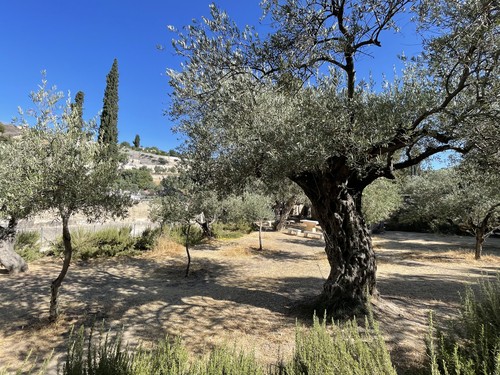
An olive tree on the Mt. of Olives. They can grow to be 100s of years old. - Israel 2022 
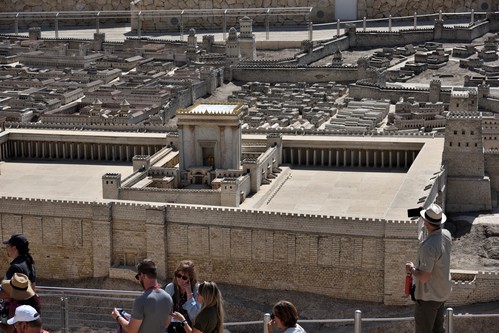
A model of the Temple at 1:50 scale at the Israel Museum. This would have been how the Temple looked when Jesus walked in Jerusalem - Israel 2022 

Day 2 – Monday: Jesus curses a fruitless fig tree and cleanses the temple

"The King Who Deserves True Worship"
Mark 11:12–19 and Matthew 21:12–22
On the day after His triumphal entry, Jesus returns to Jerusalem—not to receive applause, but to confront the reality of worship. In Mark 11:12–19 and Matthew 21:12–22, we see two powerful actions: Jesus curses a fruitless fig tree and cleanses the temple. Both moments reveal a sobering truth—the King who must be praised is not honored by empty religion, but by genuine, fruitful worship.
The fig tree looked healthy from a distance, full of leaves, yet it bore no fruit. It was a picture of Israel—and a warning for us. Outward appearances can be deceiving. It is possible to look spiritually alive but be inwardly barren. Jesus’ response shows that He desires more than appearance; He desires fruit—lives marked by faith, obedience, and transformation.
Then Jesus enters the temple and overturns the tables of the money changers. The place meant for prayer had become a place of profit. Worship had been replaced with convenience and corruption. Jesus declares, “My house shall be called a house of prayer for all nations,” but they had made it a den of robbers. The King who rode in humbly on Sunday now stands in authority on Monday, demanding that worship be restored to its rightful place.
Reflection
The praise Jesus deserves is not just loud—it is true. It is not confined to songs on Sunday but expressed in lives that bear fruit every day. The question this passage asks is simple but piercing:
Is my life producing spiritual fruit, or just spiritual appearance?
Is my worship centered on God, or has it become routine and self-focused?
If Jesus walked into the “temple” of my life today, what would He need to cleanse?
Application
Today is an invitation to realign your heart with the King:
Examine your fruit – Are you growing in love, obedience, and faith?
Cleanse your temple – Confess anything that has taken God’s rightful place.
Renew your worship – Spend intentional time in prayer and sincere praise.
True praise flows from a heart that is fully surrendered to the King.
Prayer
Lord Jesus, You are the King who must be praised—not just with words, but with a life that honors You. Search my heart and reveal anything that is empty or unfruitful. Cleanse me where I have allowed distraction, sin, or routine to replace true worship. Help me to bear fruit that glorifies You and to live a life that reflects Your worth. May my praise be genuine, my faith be active, and my heart be fully Yours. Amen.


Day 1 – Palm Sunday: The Triumphal Entry

“The King Who Must Be Praised”
Luke 19:38–40
As Jesus entered Jerusalem in what we often call the Triumphal Entry, the crowds cried out: “Blessed is the King who comes in the name of the Lord! Peace in heaven and glory in the highest!” This was not a random outburst of excitement—it was deeply rooted in the language of worship from the Old Testament, especially Psalms. In particular, their words echo Psalm 118:26: “Blessed is he who comes in the name of the Lord.” This psalm was traditionally sung during Passover, the very season in which Jesus entered the city. The people were, whether fully understanding it or not, proclaiming Jesus as the long-awaited King.
Yet this King did not arrive as many expected. He came riding on a colt—humble, peaceful, fulfilling the prophecy of Zechariah 9:9. He was not a political conqueror but a Savior who would bring peace not through force, but through sacrifice. The praise of the crowd pointed to a greater truth: Jesus is the rightful King, sent by God, worthy of honor and worship.
The religious leaders, however, were troubled by this public declaration. They asked Jesus to rebuke His disciples. But His response is striking: “I tell you, if these were silent, the very stones would cry out.” Creation itself recognizes the authority and glory of the King. This moment reveals a powerful truth—praise is not optional when the King is present. If people refuse, creation will testify.
This connects again to the Psalms. Throughout Psalms, we see a call for all creation to praise God—trees, rivers, mountains, and all living things (Psalm 96, 98). The Triumphal Entry is a living picture of those psalms coming to life. The King has come, and all of creation is ready to respond.
Application
The question for us is simple: Will we join in the praise? Jesus is still the King—worthy, present, and deserving of worship. We heard Pastor Carlos teaching in Revelation that we will worship God for eternity. We should not wait for a future time or a crowd to stir our hearts or for circumstances to be ideal. The truth of who He is demands a response. Worship Him today and forever.
Let your life be louder than the stones. Worship Him not only with your words, but with your obedience, your surrender, and your daily walk. The King has come—and He is worthy of all praise.
Prayer
Lord Jesus, You are the true King, humble yet powerful, worthy of all glory. Forgive me for the times I have been silent when I should have praised You. Help me to recognize Your presence in my life and respond with wholehearted worship. Let my life declare Your greatness so that even the stones will not need to cry out in my place. Amen.


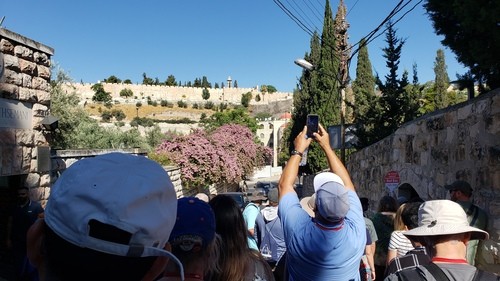
Looking at the East Wall of the Temple from the Mount of Olives walking down the Palm Sunday Road - Israel 2022